Dry eye is one of the most undertreated conditions in eye care — not because effective treatments don't exist, but because it requires a different approach than most eye conditions. There is no single prescription that cures it. There is no one-size-fits-all protocol. The patients who achieve lasting, meaningful relief are almost always the ones who commit to a layered, individualized treatment plan — and who work with a practice that is equipped to build and adjust that plan over time.
At Toluca Lake Optometric Center in Burbank, CA, dry eye care is a structured clinical process. Here is how we build a treatment plan from the ground up.
Step 1: Comprehensive Diagnostic Evaluation
No treatment plan can be built without knowing what is driving the disease. Dry eye has multiple subtypes — evaporative dry eye from meibomian gland dysfunction, aqueous-deficient dry eye from reduced lacrimal gland production, mixed dry eye, and dry eye with significant ocular surface disease — and the treatments that work for one may be largely ineffective for another.
Our initial evaluation includes:
- Symptom quantification using validated questionnaires to establish a baseline
- Infrared meibography to visualize gland structure and identify the extent of gland atrophy
- Tear film breakup time to assess tear film stability
- Meibomian gland expression quality to evaluate what the glands are actually producing
- Ocular surface staining to identify areas of active corneal and conjunctival damage
- Lid and lash evaluation for blepharitis, Demodex collarettes, rosacea, and lid position abnormalities
- Schirmer testing if aqueous deficiency is suspected
This full picture tells us not just that you have dry eye, but which mechanisms are driving it and how advanced the structural changes are.
Step 2: Addressing Underlying Lid Disease
Most chronic dry eye is rooted in the eyelids. Before or alongside advanced treatments, we need to get the lid environment under control.
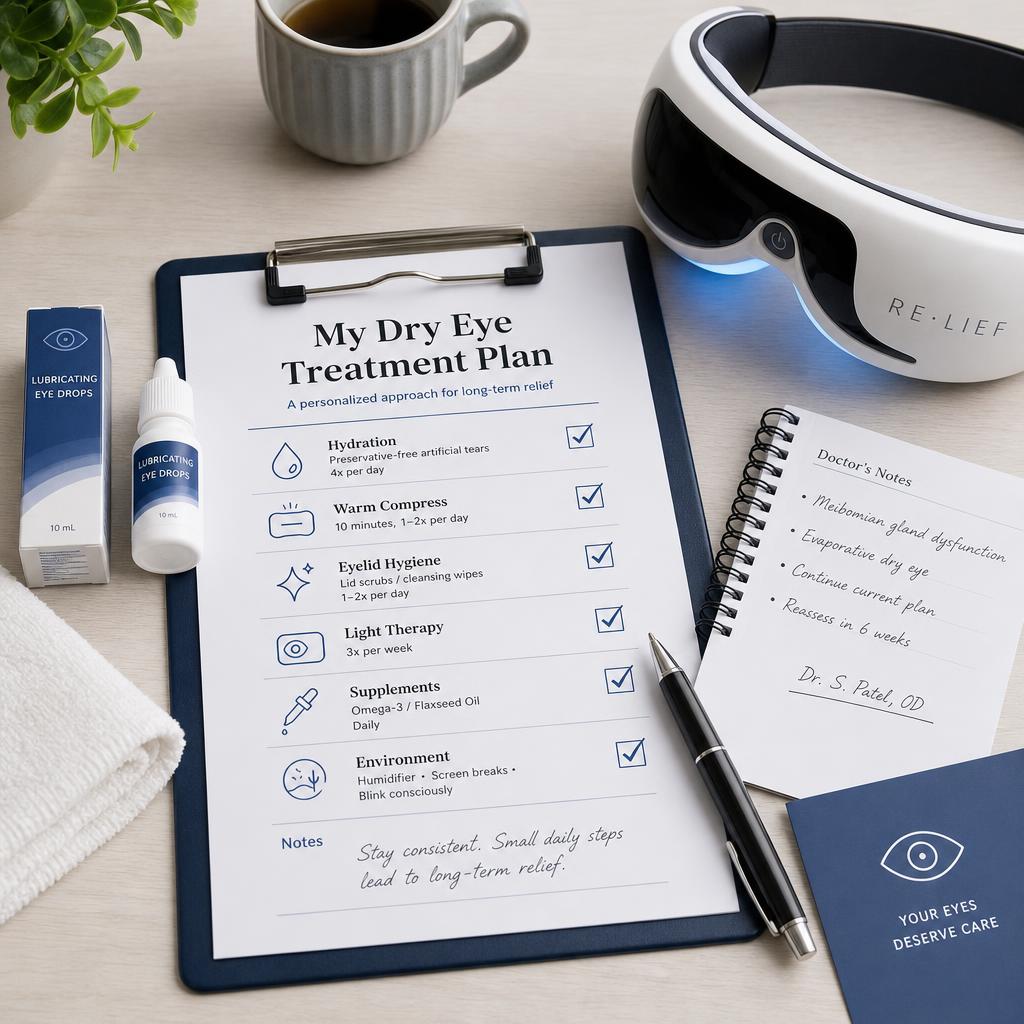
Blepharitis — bacterial or seborrheic inflammation of the lid margins — requires lid hygiene with appropriate cleansers. Warm compresses and lid wipes create the foundation for healthier glands.
Demodex blepharitis requires targeted treatment to kill the mites — currently prescription lotilaner (XDEMVY) is the most effective option, combined with lid debridement.
Rosacea-related lid disease requires both systemic awareness (managing rosacea triggers) and targeted periocular treatment.
Without controlling lid disease, higher-level treatments operate against a headwind — the inflammation you are treating keeps being replaced by the ongoing lid disease.
Step 3: In-Office Meibomian Gland Treatment
For patients with significant meibomian gland dysfunction — which is most of our dry eye patients — in-office gland treatment is typically the most impactful intervention:
OptiLight IPL is our primary tool for treating the inflammatory drivers of MGD. A series of three to four sessions, spaced three to four weeks apart, targets the abnormal periocular blood vessels that carry inflammatory mediators and helps liquefy thickened gland secretions. For patients with rosacea or significant periocular vascular inflammation, IPL often produces the most dramatic improvement.
Low-level light therapy (photobiomodulation) is added for patients with complex or refractory dry eye, or those who need a different anti-inflammatory mechanism. PBM works at the cellular level to reduce inflammation and support gland cell metabolism.
Meibomian gland expression follows each IPL session to physically clear the softened secretions from the glands and restore flow.
Step 4: Optimizing the Tear Film
Once the glands are being treated, we optimize the tear film from multiple angles:
Omega-3 fatty acid supplementation (particularly EPA and DHA from triglyceride-form fish oil, not re-esterified forms) improves the quality of meibomian gland secretions over time. Most patients need at least three months of consistent supplementation before seeing a meaningful effect.
Prescription eye drops — Restasis, Xiidra, or Cequa — address the inflammatory component of the ocular surface for patients with chronic surface inflammation and aqueous deficiency. These require months of consistent use and work best alongside, not instead of, gland treatment.
Preservative-free artificial tears are recommended for patients who need supplemental lubrication. Preserved drops can worsen surface inflammation with frequent use.
Punctal plugs reduce tear drainage for patients with aqueous deficiency, keeping existing tears on the eye longer. We use plugs selectively — they are not appropriate for patients with significant inflammatory dry eye where keeping inflammatory cytokines on the surface is counterproductive.
Step 5: Monitoring and Adjusting
Dry eye management is not a set-it-and-forget-it process. We schedule follow-up visits to assess how the glands are responding, repeat meibography to track structural changes, re-measure tear film stability, and reconsider the plan based on your progress.
Some patients respond quickly to a first series of IPL and maintain well with minimal intervention. Others have more complex or advanced disease and require ongoing combination treatment. The plan evolves based on your response — not a fixed protocol applied the same way to every patient.
The Goal: Long-Term Comfort, Not Symptom Management
The difference between treating dry eye and managing dry eye is whether the plan addresses the underlying disease or just provides temporary relief. Our goal for every patient is to get the glands working better, reduce the inflammatory burden on the ocular surface, and reach a level of comfort that persists — not just for days, but for months at a time with appropriate maintenance.
If you are ready to move beyond drops and find out what is actually driving your dry eye, call Toluca Lake Optometric Center in Burbank at (818) 841-1212 to schedule a comprehensive dry eye evaluation.