Most people choose IPL for one reason. They come to us frustrated by chronic dry eye that has not responded to drops, or they are bothered by facial redness and sun damage and want clearer skin. What surprises nearly every patient is that IPL treats both at the same time — and that the two benefits are deeply connected, not just a coincidence.
At Toluca Lake Optometric Center in Burbank, CA, we offer Lumenis OptiLight, the most clinically validated IPL platform available for this type of care. Understanding what Lumenis is, how OptiLight works, and what it actually does for your eyes and your skin helps explain why this treatment has become one of the most requested services in our practice.
Who Is Lumenis?
Lumenis is an Israeli-based medical technology company with more than 50 years of experience pioneering energy-based treatments for ophthalmology, dermatology, and aesthetic medicine. They are not a cosmetic brand — they are a medical device company whose technology is used in hospitals, surgical centers, and specialty clinics around the world.
Lumenis invented some of the first therapeutic lasers ever used in medicine. Over the decades, they have continued developing and refining platforms that deliver precise, controlled light energy for both medical and aesthetic applications. Their products include surgical systems used in cataract and glaucoma care, professional laser hair removal platforms, and the OptiLight IPL system — the first and only IPL device FDA-approved specifically for the treatment of dry eye disease.
When we say we use Lumenis technology, we mean we are using the clinical gold standard, not a generic or off-brand device. That distinction matters for safety, efficacy, and results.
What Is IPL and How Does It Work?
IPL stands for Intense Pulsed Light. It delivers controlled flashes of broad-spectrum light — not a laser, which uses a single focused wavelength, but a carefully filtered range of wavelengths tuned to interact with specific targets in the skin and underlying tissue.
Different tissues absorb different wavelengths of light. Hemoglobin in blood vessels absorbs certain wavelengths, causing those vessels to coagulate and close. Melanin in pigmented spots absorbs others, breaking up discoloration. The warmth generated by IPL also penetrates into the deeper tissue layers, influencing the oil-producing glands beneath the eyelids and stimulating the skin's natural repair response.
Because IPL uses multiple wavelengths simultaneously, it can address several targets in a single pass — which is why it works so effectively for both dry eye and skin concerns at the same time.
OptiLight, Lumenis's dry eye-specific IPL platform, uses a patented technology called Optimal Pulse Technology (OPT), which delivers perfectly consistent, square-shaped pulses of light with every flash. This precision is what makes Lumenis devices more reliable and more controllable than standard IPL systems.
IPL for Dry Eye: Treating the Root Cause
Most people with chronic dry eye are dealing with a condition called meibomian gland dysfunction, or MGD. The meibomian glands are small oil-producing glands that line the upper and lower eyelids — about 25 to 30 per lid. Every time you blink, these glands release a thin layer of oil onto the surface of the tear film. That oil layer is what slows tear evaporation and keeps your eyes comfortable.
When the meibomian glands become inflamed, blocked, or otherwise dysfunctional, the oil layer breaks down. Tears evaporate too quickly. The surface of the eye dries out. The result is the familiar cycle of burning, grittiness, redness, fluctuating vision, and light sensitivity that defines chronic evaporative dry eye.
IPL addresses this from multiple angles at once:
Reducing Periocular Inflammation
One of the key drivers of meibomian gland dysfunction is chronic inflammation along the eyelid margins and the skin surrounding the eyes. Patients with rosacea are especially prone to this — the inflammatory processes that cause facial redness also affect the eyelids and the meibomian glands, often without patients even realizing the two are related.
IPL targets the abnormal, dilated blood vessels that carry and release inflammatory mediators around the eye. By closing these vessels, it reduces the inflammatory load on the eyelids. Fewer inflammatory signals mean healthier glands, more consistent oil production, and a more stable tear film.
Clearing and Reactivating the Glands
The gentle warmth that IPL delivers during treatment helps liquefy the thickened, waxy secretions that clog meibomian glands in many dry eye patients. When those blockages clear, the glands can begin functioning properly again. Many patients receive meibomian gland expression following their IPL treatment to physically clear the glands once the oil inside has been softened.
Reducing Demodex and Bacterial Load
Research has shown that IPL is effective at reducing the population of Demodex mites — microscopic organisms that live in the hair follicles of the lashes and can overpopulate in people with lid disease and blepharitis. An elevated Demodex count contributes directly to eyelid inflammation and gland dysfunction. IPL's light energy reduces this population, improving the overall health of the eyelid environment.
What Patients Experience
Dry eye relief from IPL tends to build gradually over a series of treatments. Most patients complete an initial course of three to four sessions spaced three to four weeks apart. Following the series, many maintain their results with periodic touch-up treatments every six to twelve months.
Patients commonly report a noticeable reduction in eye burning, reduced dependence on artificial tears, improved morning comfort, clearer and more stable vision, and less eyelid redness and irritation. Because IPL treats the dysfunction itself rather than simply lubricating the surface, the results last far longer than drops alone.
IPL for Skin: Visible Improvements That Go Beyond the Eyes
The same treatment that benefits your tear glands also works on the surrounding skin — and the improvements there can be equally meaningful.
Rosacea and Persistent Facial Redness
Rosacea is one of the most common conditions IPL is used to treat. It causes chronic redness, visible blood vessels, and flushing across the cheeks, nose, and chin — and in many patients, it also affects the eyes. IPL targets the hemoglobin in dilated capillaries, causing them to collapse and be reabsorbed by the body. Over a series of treatments, the persistent red tone across the face significantly diminishes. For patients whose ocular rosacea is contributing to dry eye, treating the facial component with IPL also benefits the eyes — the connection goes in both directions.
Sun Damage and Hyperpigmentation
Sunspots, age spots, freckles, and uneven pigmentation accumulate over years of sun exposure. IPL targets melanin — the pigment responsible for these spots — breaking it up so the body can clear it naturally. Treated spots typically darken briefly in the days following treatment before flaking off, revealing cleaner, more even skin beneath. The result is a clearer complexion with a more uniform tone.
Broken Capillaries and Visible Vessels
Beyond the diffuse redness of rosacea, many patients have specific visible vessels — small broken capillaries on the cheeks, nose, or around the eyes. IPL coagulates these selectively, reducing or eliminating them over a series of sessions without affecting the surrounding skin.
Collagen Stimulation and Skin Quality
The controlled heat that IPL delivers into the deeper layers of the skin stimulates fibroblast activity — the cells responsible for producing collagen and elastin. Over weeks following treatment, as the skin responds and repairs, patients notice improvements in texture, firmness, and the softening of fine lines. These changes are gradual and natural-looking rather than dramatic, which is why many patients describe their skin as simply looking healthier and more rested.
The Dual Benefit: Why This Combination Is Unique
What makes IPL at Toluca Lake Optometric Center different from a purely cosmetic setting is that we approach it from an eye health foundation. We are not offering IPL as a skincare add-on — we are offering it as a medical treatment for dry eye that also happens to improve the skin.
This matters because the overlap between dry eye and facial skin conditions is significant. Rosacea is one of the most common root causes of ocular inflammation and meibomian gland dysfunction. Sun damage and chronic eyelid inflammation often coexist. By treating both simultaneously, patients get more complete relief — and often discover that their skin improvement is as meaningful to them as their dry eye relief.
For patients who have tried artificial tears, warm compresses, omega-3 supplements, and prescription drops with limited results, IPL frequently provides the breakthrough. It reaches the dysfunction that surface-level treatments cannot.
What to Expect at Toluca Lake Optometric Center
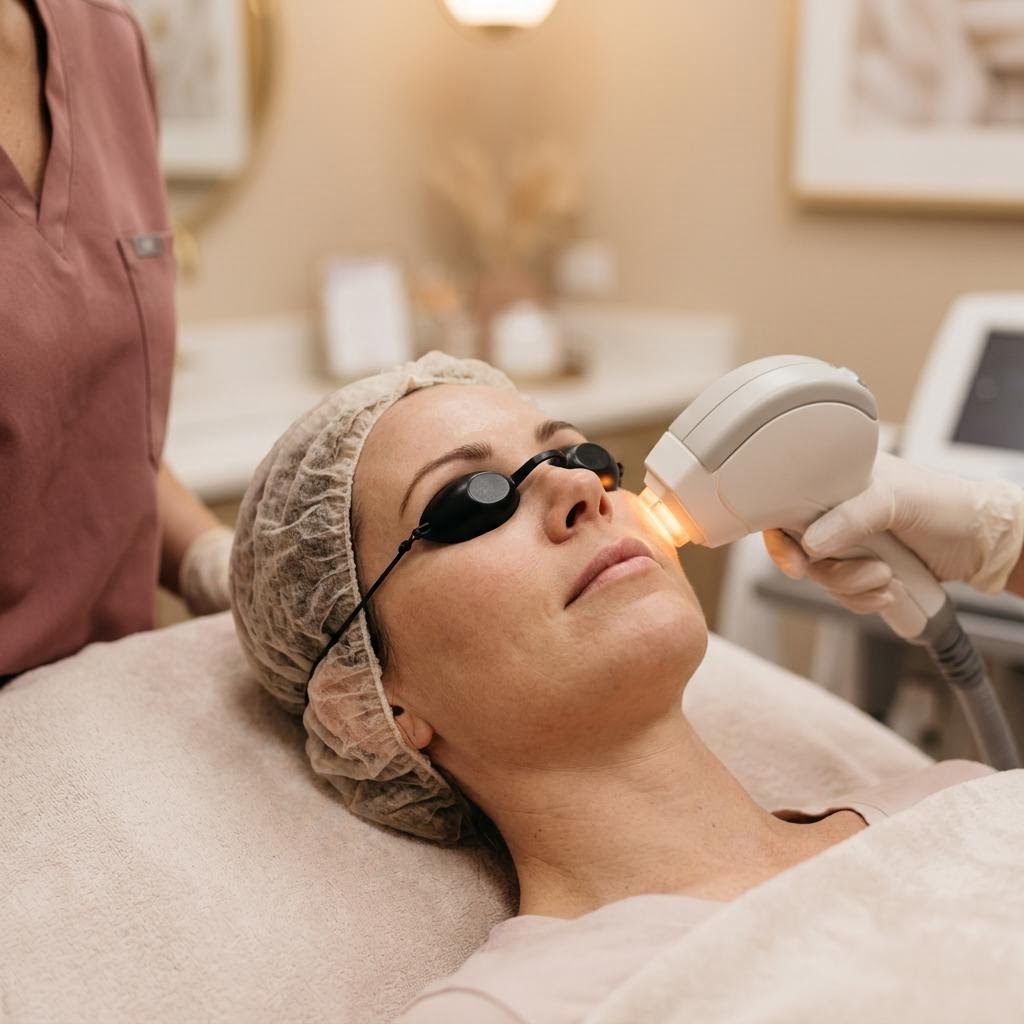
Each IPL session with OptiLight takes approximately 10 to 15 minutes. Protective shields are placed over the eyes, and the handpiece delivers a series of precisely controlled light pulses across the cheeks and lower eyelids. The sensation is often described as a brief, warm snap — most patients find it comfortable and do not require any numbing. There is no downtime. Skin may appear slightly flushed for a few hours afterward, similar to mild sun exposure.
Results build across sessions. Most patients complete their initial series of three to four treatments before experiencing full improvement. Maintenance sessions every six to twelve months help sustain the results for both dry eye and skin.
Schedule a Consultation in Burbank
If you have been managing chronic dry eye with drops and getting limited relief, or if you are bothered by rosacea, sun damage, or uneven skin tone — or both — IPL with Lumenis OptiLight may be one of the most impactful treatments available to you.
Contact Toluca Lake Optometric Center in Burbank, CA to schedule a consultation and find out whether IPL is the right fit for your eyes and your skin. Call us at (818) 841-1212 or reach out online to get started.